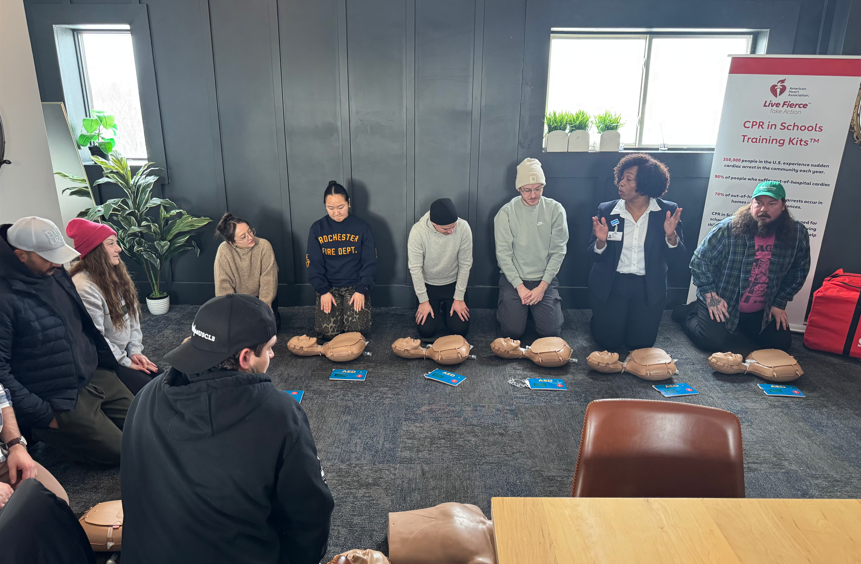
When someone’s heart stops pumping, early CPR can save their life[1]. CPR, especially if performed immediately, can double or triple a person’s chance of survival. That is why the American Heart Association, along with sponsor Rochester Regional Health, brought CPR training to the restaurant industry on Monday.
The American Heart Association and Rochester Regional Health are working together to expand the Nation of Lifesavers. As part of this two-year program, the organizations brought together restaurant managers from Bitter Honey, Branda Midtown, The Revelry, Patron Saint, Velvet Belly and Ziggy’s for a Hands-Only CPR demonstration at Velvet Belly on Monday afternoon. The demonstration focused on how restaurant workers can identify and respond to cardiac emergencies.
Hands-Only CPR demonstration participants learned the correct rate and depth of compressions and how to use an automated external defibrillator, or AED. Compression-only CPR, known as Hands-Only CPR, can be equally effective as traditional CPR in the first few minutes of emergency response and is a skill everyone can learn. It is as simple as calling 911 if you see a teen or adult suddenly collapse and then push hard and fast in the center of the chest.
“Rochester Regional Health is proud to collaborate with the American Heart Association to bring this lifesaving information to the local restaurant industry,” said LeKeyah Wilson, MD, VP of Community Engagement and Social Impact for Rochester Regional Health. “Every minute counts in a cardiac emergency and giving people the skills to save lives is essential anywhere people gather. Restaurant workers could be called on as first responders before help arrives. Empowering them with the tools and knowledge to respond makes our communities stronger—and we’re here for it.”
Today, more than 350,000 cardiac arrests occur outside of hospitals in the United States annually. Nearly three out of four of those cardiac arrests happen in homes. Tragically, 90% of the time, these incidents prove fatal[2]. The American Heart Association, a global force devoted to changing the future in pursuit of healthier lives for all, mobilized its Nation of Lifesavers™ movement in 2023 with a goal to double survival rates from sudden cardiac arrest for everyone, ensuring more people at home, work, school and even online have learned lifesaving CPR skills.
Data released earlier this year, conducted by Decision Analyst on behalf of the American Heart Association, indicates more U.S. adults now say they feel ready to handle and respond to a cardiac arrest[3]. When Damar Hamlin collapsed on the field during Monday Night Football in January of 2023, nearly seven out of every ten U.S. adults said they would not feel confident to act during a cardiac emergency. Based on the available data at the time, and tracking attitudes since, the Association has since seen a reported increase from 33% to 39% in bystander confidence to be able to perform any type of CPR — or 17.7 million more Americans feeling confident to act in the event of a lifesaving emergency.
“Our strategy is working. This increase in confidence to perform CPR is confirmation and represents not only the success in our awareness and education efforts, but more importantly, the additional lives saved when someone with training responds in an emergency,” said Megan Vargulick, executive director of the American Heart Association in the Rochester region. “Cardiac arrest can affect anyone, regardless of age or health — even the youngest among us are not immune. Be ready when it matters most.”
Quick, simple and easy-to-learn, Hands-Only CPR has been shown to be as effective in the first few minutes as conventional CPR for cardiac arrest at home, at work or in public[4].
The Association encourages everyone, regardless of where they live, to take 90 seconds to learn how to save a life now at www.heart.org/HandsOnlyCPR.
[1] Panchal AR, Bartos JA, Cabañas JG, Donnino MW, Drennan IR, Hirsch KG, Kudenchuk PJ, Kurz MC, Lavonas EJ, Morley PT, O’Neil BJ, Peberdy MA, Rittenberger JC, Rodriguez AJ, Sawyer KN, Berg KM; on behalf of the Adult Basic and Advanced Life Support Writing Group. Part 3: adult basic and advanced life support: 2020 American Heart Association Guidelines for Cardiopulmonary Resuscitation and Emergency Cardiovascular Care. Circulation. 2020;142(suppl 2):S366–S468. doi: 10.1161/CIR.0000000000000916
[2] Martin et. al. 2024 Heart disease and stroke statistics: a report of U.S. and global data from the American Heart Association. Circulation. 2024;149(8):e347-e913. doi: 10.1161/CIR.0000000000001209.
[3] 2024 CPR Perceptions Survey, conducted for the American Heart Association. Available upon request.
[4] https://www.ahajournals.org/doi/10.1161/CIR.0000000000001052?utm_campaign=2023stat-update&utm_source=heart&utm_medium=link&utm_content=statshome