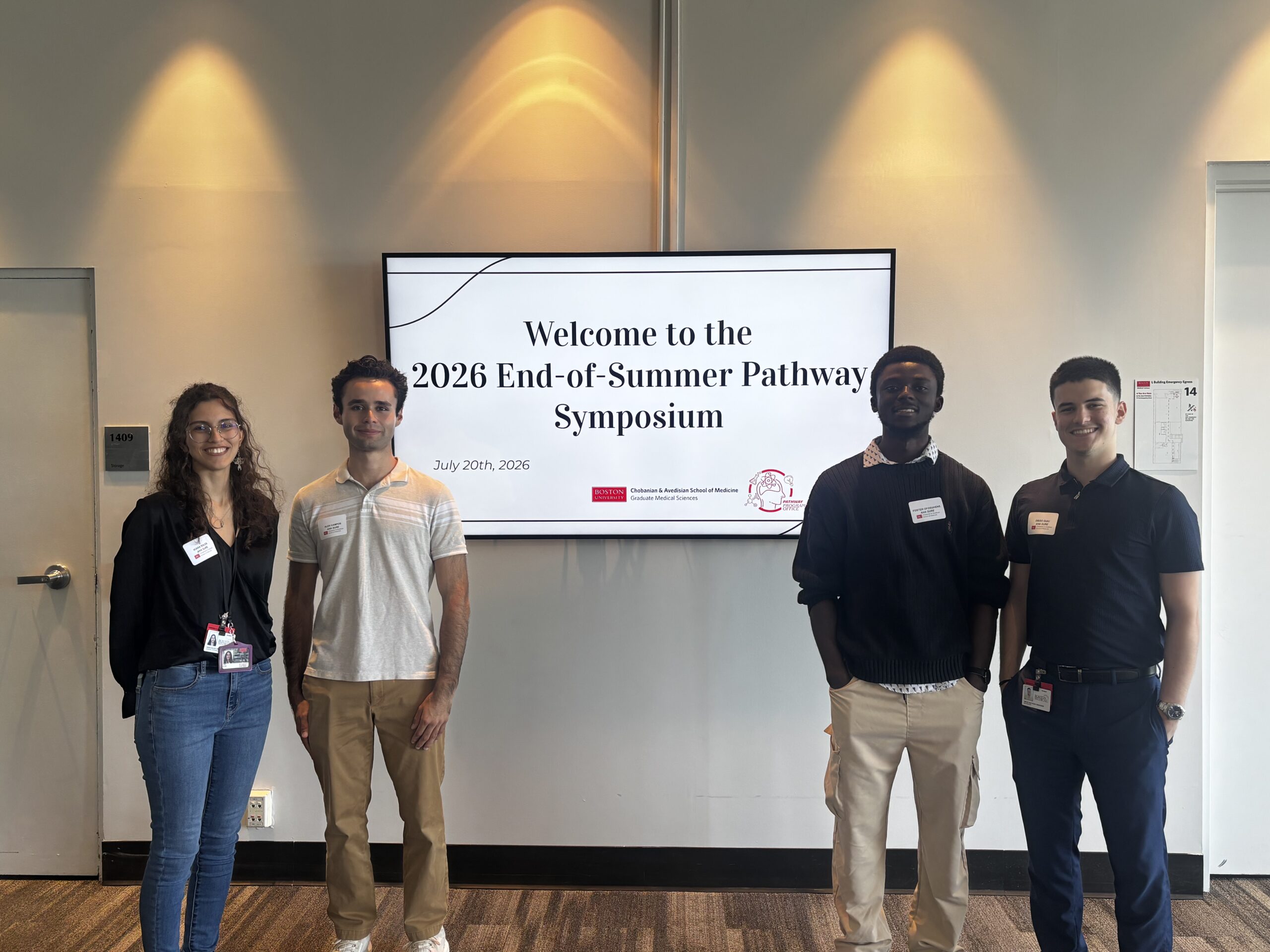
This summer, Alex Campos returned to the city where he was born with a question that was both scientific and personal: how can research help close the gaps he had seen growing up between people with access to health care and those without it?
A rising junior at Johns Hopkins University, Campos grew up in Lima, Peru, where he had lived between “both of these realities,” seeing the contrasts between privilege and poverty and how they shaped people’s health.
By the end of the summer, he had spent weeks inside the world of cardiovascular research, studying what factors might influence a person’s willingness to donate organs after death for scientific research. The work brought him into outpatient cardiology settings at Boston Medical Center and confirmed his goal of pursuing a medical degree.
Campos was one of four undergraduate students in the Boston cohort of the American Heart Association’s SURE Scholars program, short for Supporting Undergraduate Research Experiences. Hosted at Boston University Chobanian & Avedisian School of Medicine, the program gives students hands-on research experience, mentorship and a clearer view of what a future in medicine might look like.
During a recent virtual reception with American Heart Association staff and supporters, the students discussed their summer projects, reflected on their paths and spoke about how the experience shaped their ambitions.
The Boston cohort was led by Emelia Benjamin, MD, a cardiologist and professor at Boston University and longtime American Heart Association volunteer. She described the program as a “passion project” and said the scholars represent the future of research.
For Diego Guiu Santiago, a student at Miami Dade College from Havana, Cuba, the summer brought him deeper into the connection between heart health and brain health. He studied how health factors such as diet, exercise and sleep may be associated with cognitive performance in older adults.
Foster Ofosuhene, a student at Hampton University who grew up in Kumasi, Ghana, approached cardiovascular research through the lens of access. He said his community had only one medical center, and patients needing major surgeries had to travel 30 to 40 miles away, a barrier that helped motivate his interest in building cardiovascular care capacity in Ghana someday.
Kiara Soler, a student at the University of Puerto Rico, brought a different but related concern to her research: how to support heart health after hypertensive pregnancies. Her project examined whether group medical visits could be an effective way to provide postpartum cardiovascular disease prevention care for patients who experienced high blood pressure during pregnancy.
Soler said the work opened her eyes to the scale of disparities affecting postpartum care and showed her that a large city like Boston can face problems similar to those she has seen in her hometown of Caguas, Puerto Rico, including shortages of physicians and specialists. She said the experience strengthened both her interest in medical school and research.
Threaded through the students’ presentations was a common theme: each arrived with a personal reason for caring about science, and each left with a broader sense of what research can do. For some, the summer meant learning to code for the first time. For others, it meant shadowing physicians, writing scientifically, working with large data sets or seeing firsthand how clinical research connects to the lives of patients.
Benjamin said the program gave many of the students their first chance to conduct science and gain clinical research experiences. She credited the support of Peter Lawrence, president and CEO of Cardurion Pharmaceuticals, and the Heart Disease Research Foundation, with supporting the program.
The need for those opportunities is clear, she said. The Boston program selected four students from 70 applicants, and Benjamin said there were many more strong candidates than available spots.
Michele Lentz, vice chair of the Heart Disease Research Foundation, said the students’ projects pointed to gaps that still need attention, including women’s heart health, prevention and access to research opportunities. Lawrence praised the students’ desire to be “change agents” and encouraged them to hold on to their ideals, whether their careers eventually lead them to academia, medicine, biotechnology or another path.
For the scholars, the summer was not just a research placement. It was an introduction to a larger community of scientists, physicians, mentors and supporters who believe early opportunity can shape the future of medicine. And for four students who came to Boston with different backgrounds and different questions, it offered a glimpse of the kind of change they may one day help lead.