Hypertension remains a significant public health concern, mostly because it often goes unnoticed until serious health threats occur, such as heart attacks or stroke.
The American Heart Association works with community organizations to manage and prevent hypertension by implementing blood pressure screening stations at places where clients already receive other health services. To expand this initiative, we are partnering with schools in the Greater Washington Region.
Fox Chapel Elementary School, located in Germantown, Md., is the first school in Montgomery County to implement a community blood pressure screening station. Fox Chapel Elementary School is in its first year as a designated community school, providing services and resources for students, families, and the broader community. Fox Chapel is home to a majority population of Hispanic and African American students, families, and community members who face a higher risk of hypertension.
Ana Hernández, community liaison, is deeply committed to addressing the comprehensive needs of Fox Chapel families and neighbors.
“Being able to partner with the Association to implement a blood pressure screening station will provide Fox Chapel families a safe and trusted place to get screened right here at their child’s school,” said Hernández. “We have a lot of families who walk to school and rely on public transportation. The mere fact that we now have the screening station at our school reduces barriers for them. With the screening station, along with our other services that we provide, we are a one-stop shop, providing comprehensive services and support to everyone in the community, not just our students.”
Within the past year of becoming a designated community school, Hernández has established a community suite within the school building that serves as a hub for clothes, supplies, and resources for those in need in the community. Ana has also recently expanded the resources within this community suite to offer a blood pressure screening station as an added resource for community members. Ana has worked closely with Fox Chapel’s school nurse, Laura Clark, on this initiative to reduce barriers between the community and access to local healthcare services.
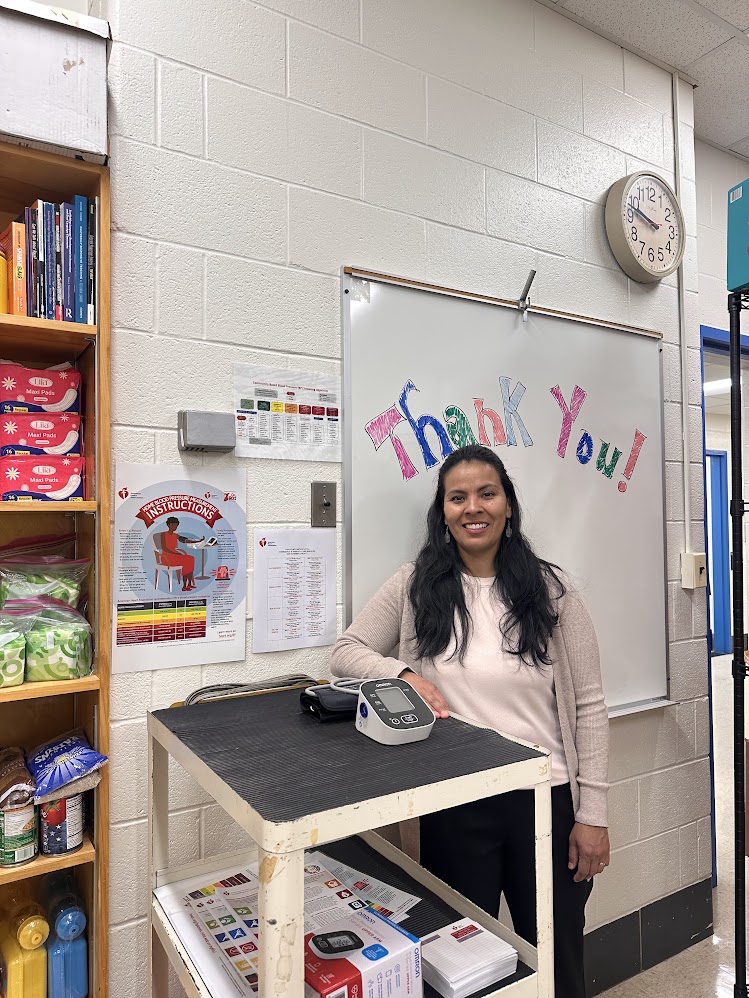
The Association has provided this community suite with a blood pressure monitor, training for use of the monitor, educational posters and infographics both in English and Spanish, as well as a list of low-cost of free clinics for individuals to be referred to. Adding blood pressure measurement devices to this site helps ensure community members get health care in a setting they already trust.
Community blood pressure screening stations are established to close gaps between individuals and healthcare providers through strengthening community to clinical linkages that we help to facilitate. This initiative helps to empower individuals to take control of their health to support a long, heart healthy life.
Nearly half of adults in the United States have been diagnosed with hypertension and 28.1% of adults in the Greater Washington region are affected, showing how strongly hypertension impacts our local communities. Hypertension is often called the “silent killer,” as it typically affects individuals without obvious symptoms. Although the risk for hypertension increases with age, there are also many other risk factors that can cause hypertension, such as race, genetics, diet, obesity, low exercise, tobacco use, and stress. Given the serious risks associated with hypertension, community-based approaches implemented through local organizations and schools for prevention, early detection, and treatment are extremely important for reaching underserved and high-risk populations in our local communities.
Anyone can take steps to improve their heart health; Life’s Essential 8 is a guide that outlines eight key lifestyle measures that individuals can manage to support their cardiovascular health: eating better, being more active, quitting tobacco, getting healthy sleep, managing weight, controlling cholesterol, managing blood sugar, and managing blood pressure.
Schools or organizations interested in implementing this initiative or would like to learn more, please contact Community Impact Director, Lucía Zegarra at lucia.zegarra@heart.org.
Written by Molly O’Keefe, Health Strategies Intern