By Neil A. Nadkarni, MD, Director of the Neurovascular Inflammation Team (NVITe), Laboratory, Department of Neurology, Stony Brook Medicine
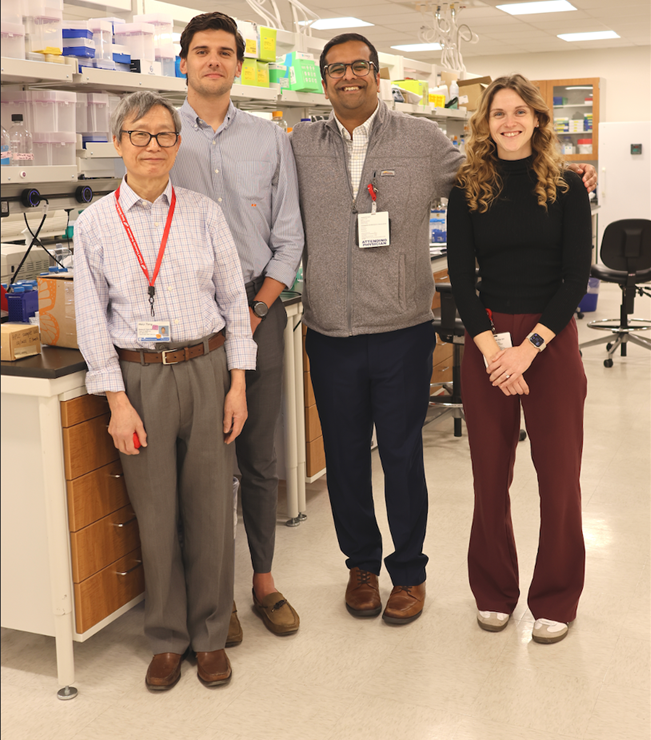 The NVITe Lab at Stony Brook University (left to right: Meiyi Tang, PhD, Senior Research Scientist; Miguel Madeira, PhD, American Heart Association-Supported Postdoctoral Fellow; Neil A. Nadkarni, MD, Lab Director; Laurel Schappell, MS, American Heart Association-Supported Predoctoral Fellow) studies how the timing and location of immune cell interactions after stroke shape recovery – and how manipulating these relationships – could lead to new therapies. To do this, they use mouse models of stroke with the intent of extending their findings from the bench to the bedside.
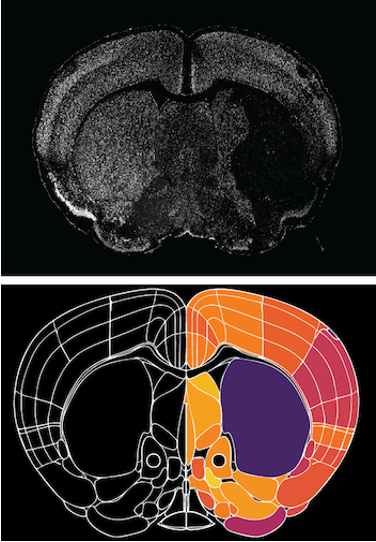 Using an imaging technique called light-sheet microscopy, they create precise three-dimensional maps of where neurons are injured and where brain immune cells encounter the blood immune cells that flood the brain after stroke. By doing so, they can understand where and how these two types of immune cells interact.
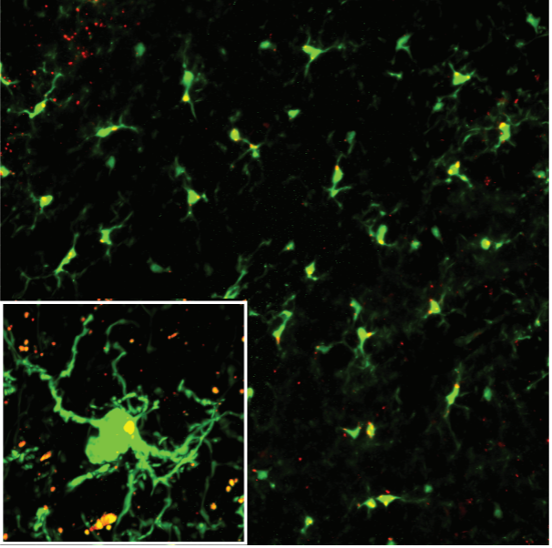 They can also precisely manipulate brain immune cells (green) by equipping them with designer receptors (red), allowing researchers to selectively activate or silence their activity (yellow) at defined points during stroke recovery to learn how each cell type contributes to stroke injury or recovery.
In an ever-changing world with new advances every day, stroke-related disability is a constant. But it doesn’t have to be. Though we can limit some of the initial damage caused by stroke, the reality is that ischemic stroke continues to impair quality of life at a staggering scale, affecting over 800,000 Americans annually*. Many of those who survive stroke still have physical and mental impairments that greatly impact independence and quality of life. The treatments for these lasting effects are limited. Luckily, there is a path forward. Developing the infrastructure for research programs focused on meaningful translational science is crucial to creating next-generation therapies for this complex disease.
The American Heart Association is committed to improving stroke outcomes and nurturing the research pipeline. My laboratory in the Department of Neurology at Stony Brook Medicine has received generous funding from the Heart Association for our work. I am motivated to understand what drives the wide variation in stroke recovery across patients. My group is learning that different spatial and temporal features determine how immune cells interact with an injured brain and with one another, and that these features can ultimately be manipulated to improve the lives of patients with stroke. For this reason, the NVITe lab focuses on understanding the nature of immune cells in both animal models of stroke and from blood and clot samples taken from stroke patients.
The Heart Association believes that the next generation of scientists is vital for the future of stroke, and this is evident through their pre- and postdoctoral funding programs. The trainees in my lab – Laurel Schappell, MS (an MD/PhD student) and Miguel Madeira, PhD (a Postdoctoral Fellow) – proposed their own projects to the Heart Association to better understand stroke immune cell biology and successfully secured funding. Laurel’s project focuses specifically on how resident brain immune cells swallow and clear out blood immune cells that enter and injure the brain. Miguel’s project uses the power of genetics to selectively activate or silence brain immune cells throughout stroke recovery, depending on which cell types are helpful or harmful and when. Both projects were funded by the Heart Association for their novelty, rigor, and potential to develop new stroke therapies. Their work uses cutting-edge techniques to visualize and manipulate stroke-immune cells and to understand how changes in individual cells can affect the body and brain as a whole.
The clinical therapies of the future begin with creative work at the lab bench. Regardless of the disease, there is no treatment on the market that did not start in the lab. The work that the Heart Association funds is building the scientific foundation for future breakthrough treatments. The Heart Association’s investment is bringing together a nationwide community of researchers committed to turning laboratory discoveries into therapies that change the lives of patients with stroke.
N.B.: The views and scientific perspectives expressed in this blog post are those of the author(s) and do not necessarily represent the official position of the American Heart Association. The scientific claims and descriptions of research herein have not yet undergone formal Heart Association science review. Dr. Nadkarni will be at the 2026 Hamptons Heart Ball on June 11, 2026 at the Oceanbleu, Westhampton Beach, NY. Come meet his team of researchers behind the science the American Heart Association is funding to improve stroke recovery.
* Palaniappan LP, Allen NB, Almarzooq ZI, Anderson CAM, Arora P, Avery CL, Baker-Smith CM, Bansal N, Currie ME, Earlie RS, Fan W, Fetterman JL, Barone Gibbs B, Heard DG, Hiremath S, Hong H, Hyacinth HI, Ibeh C, Jiang T, Johansen MC, Kazi DS, Ko D, Kwan TW, Leppert MH, Li Y, Magnani JW, Martin KA, Martin SS, Michos ED, Mussolino ME, Ogungbe O, Parikh NI, Perez MV, Perman SM, Sarraju A, Shah NS, Springer MV, St-Onge M-P, Thacker EL, Tierney S, Urbut SM, Van Spall HGC, Voeks JH, Whelton SP, Wong SS, Zhao J, Khan SS; on behalf of the American Heart Association Council on Epidemiology and Prevention Statistics Committee and Stroke Statistics Committee. 2026 Heart disease and stroke statistics: a report of US and global data from the American Heart Association. Circulation. Published online January 21, 2026. DOI: 10.1161/CIR.0000000000001412